Article
The 2026 DevOps Pivot: From Deterministic Scripts to Intent-Based Systems
Every decade, DevOps undergoes a “Great Re-platforming.”
In the early days, many of us were script-wizards moving workloads with shell scripts, cron jobs, Jenkins jobs, and a lot of operational heroics. Then came the age of YAML—GitOps, Kubernetes, Infrastructure as Code, policy engines, and cloud-native observability. That wave brought discipline, repeatability, and scale.
Now we are at another turning point.
The next pivot is not just about better tools or faster pipelines. It is about a fundamental shift in the operator itself. We are moving from systems that execute predefined instructions to systems that can interpret signals, reason over context, and recommend or take bounded action. In other words, DevOps is moving from deterministic automation to intent-based systems.
That does not mean DevOps becomes less important. Quite the opposite. It becomes more strategic.
For years, DevOps has been the control tower of modern software delivery—guiding code from commit to production through pipelines, automation, observability, and operational discipline. In the age of Generative AI and Agentic AI, that control tower is becoming smarter. The question is no longer whether we can automate builds, deployments, or incident workflows. The real question is whether we can build intelligent delivery systems that interpret signals, recommend next actions, and operate safely within human-defined guardrails.
That, in my view, is the real 2026 pivot.
Why This Shift Is Real
This is not just another AI hype cycle layered on top of DevOps vocabulary.
The strongest signal comes from what has happened to software delivery over the last year. AI has already improved local productivity in many engineering teams, but local productivity alone does not guarantee better organizational outcomes.
That tension shows up clearly in the 2025 DORA research. AI-assisted development can accelerate certain parts of the software lifecycle, but it also amplifies the strengths and weaknesses of the underlying engineering system. Teams with healthy delivery foundations benefit more. Teams with fragile pipelines, poor observability, inconsistent standards, or weak governance often see new bottlenecks appear downstream.
That matters because DevOps has always been about more than writing code faster. It has always been about maintaining flow across the entire delivery lifecycle.
A second signal comes from emerging research on AI in CI/CD and infrastructure workflows. We are beginning to see AI agents propose or modify CI/CD configurations, infrastructure definitions, and operational workflows—not just application code. That is a meaningful step forward. It suggests we are moving past “Copilot for syntax” into a world where agents can participate in release and operations workflows in more substantive ways.
At the same time, the research is also a useful reality check. End-to-end autonomous DevOps is still immature. Recent benchmark work shows that modern agents still struggle with long-running, multi-step DevOps tasks, especially when those tasks require cross-system reasoning, dynamic tool use, and production-grade judgment.
So the shift is real—but it is not magic.
The opportunity is not to replace DevOps judgment. It is to scale it.
What Actually Changes: From Task Automation to Decision Support
Classic DevOps automation works beautifully when the sequence is known in advance.
- Run the build
- Execute the test suite
- Deploy the artifact
- Monitor health checks
- Roll back if a threshold is crossed
That model is still essential. But modern delivery systems are now too large, too distributed, and too noisy for deterministic automation alone to carry the full burden.
DevOps teams spend a surprising amount of time on work that is repetitive but not fully deterministic:
- Why did this pipeline fail?
- Is this alert real or just noise?
- Is this release safe to promote?
- What changed just before this incident?
- Is this infrastructure drift harmless or risky?
- Which runbook applies here?
- Do we have enough evidence for audit and compliance?
These are not only execution problems. They are interpretation problems.
This is where Agentic AI changes the picture.
The biggest shift AI brings to DevOps is not simply more automation. It is decision support at scale.
An intelligent delivery system can inspect a failed pipeline, correlate logs with recent code or configuration changes, identify probable causes, summarize what changed, recommend the next best action, and in some cases prepare a fix. It can assess release risk based on service criticality, recent incidents, dependency changes, test behavior, and canary telemetry. It can help during incidents by connecting traces, metrics, deploy history, tickets, and runbooks into a usable operational narrative.
That is a very different operating model from static if-this-then-that automation.
The 3 Pillars of Agentic DevOps (2026)
To thrive in this era, your engineering strategy must rest on three new pillars:
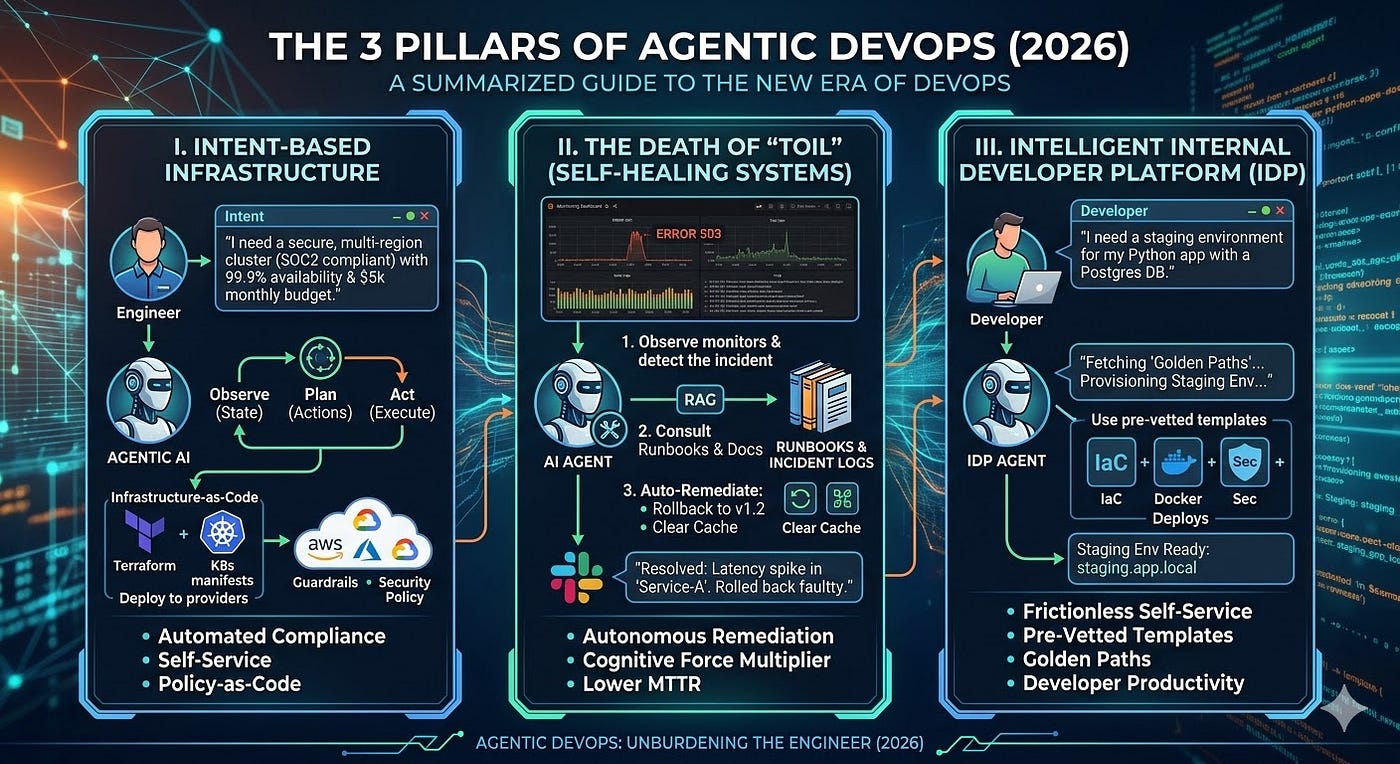
Pillar I. Intent-Based Infrastructure (Observe-Plan-Act)
We are moving away from writing 500 lines of Terraform. Instead, the engineer provides the Intent.
“I need a SOC2-compliant, multi-region database cluster with 99.99% availability and a $5k monthly budget.”
The AI Agent doesn’t just run a script; it creates an Observe-Plan-Act loop. It Observes the cloud state, Plans the necessary IaC changes, and Acts autonomously while strictly following “Policy-as-Code” guardrails.
Pillar II. The Death of Toil (Self-Healing Systems via RAG)
Traditional automation is a script; Agentic AI is a Reasoning Engine. High-impact self-healing agents now use Retrieval-Augmented Generation (RAG) to look at past incident reports and runbooks, consulting internal documentation before taking action. When an error occurs, the agent analyzes logs and executes a remediation before the human engineer even gets paged.
Pillar III. The Intelligent Internal Developer Platform (IDP)
The dream of “Developer Self-Service” is finally realized. Instead of a developer waiting three days for a database, they converse with a platform agent.
The IDP agent understands the application context and provides a pre-vetted, secure “Golden Path” instantly. Developers get frictionless self-service, dramatically increasing productivity.
This is one of the most compelling practical uses of Agentic AI in DevOps because it improves both developer experience and platform governance at the same time.
From Intent to Action: What Intelligent DevOps Actually Looks Like
If deterministic DevOps was built around fixed workflows, intent-based DevOps will be built around supervised reasoning.
In the old model, we encoded known logic into pipelines: if tests pass, deploy; if CPU spikes, trigger an alert; if health checks fail, rollback. That model still matters, but it starts to break down in noisy, distributed, fast-changing environments where the real challenge is no longer execution alone—it is interpretation.
This is where Agentic AI becomes more than a buzzword.
An intelligent DevOps system does not just execute steps. It can inspect a failing pipeline, correlate logs with recent configuration changes, identify whether the failure is due to code, environment, flaky tests, or dependency drift, and recommend the next best action. It can assess release risk using signals like service criticality, recent incidents, test behavior, and canary telemetry. It can assist during incidents by connecting traces, metrics, deploy history, and runbooks into a usable operational narrative.
But the important point is this: the value is not autonomous action for its own sake. The value is trustworthy decision support.
Where This Shows Up First
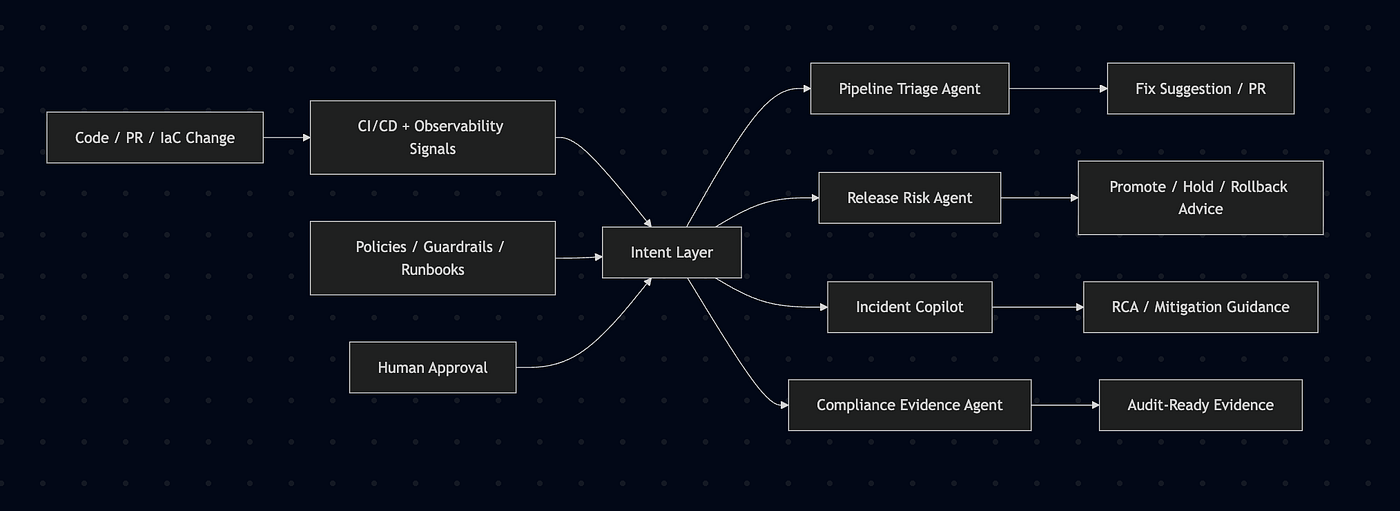
The first wave of agentic DevOps will not be autonomous everything. It will show up in high-frequency, high-toil workflows where humans spend time gathering context and making repetitive decisions.
The strongest candidates are:
- Pipeline failure triage: summarize failures, classify likely causes, suggest or generate fixes, and route to the right owner.
- Release risk assessment: combine code change size, service criticality, incident history, test trends, dependency changes, and canary results into a release confidence signal.
- Incident copilots: connect logs, metrics, traces, tickets, deploy history, and runbooks to accelerate root-cause analysis and mitigation.
- Infrastructure drift and IaC review: identify risky drift, policy violations, anti-patterns, and optimization opportunities.
- Compliance evidence assembly: collect scan results, approvals, deployment metadata, SBOMs, and policy checks into audit-ready evidence packs.
- Internal platform support: answer repeated developer questions and guide teams toward approved golden paths.
These are not hypothetical use cases. They are practical, measurable, and aligned with where AI can genuinely reduce toil today.
The Missing Idea: Bounded Autonomy
This is where many conversations about Agentic AI in DevOps go wrong.
When people hear “agentic,” they often imagine fully autonomous systems running production end to end with no human involvement. That may be the long-term aspiration in some narrow domains, but it is not the most responsible or realistic enterprise model today.
The better model is bounded autonomy.
That means AI can reason, recommend, and even act—but only within clearly defined limits.
A sensible maturity path looks like this:
- Advisor mode — the AI recommends, summarizes, and explains; humans decide.
- Assisted operator mode — the AI can take low-risk actions in development or test environments.
- Guardrailed execution mode — the AI can perform bounded production actions within policy, blast-radius, and rollback constraints.
- Escalation mode — high-risk, destructive, customer-impacting, or security-sensitive actions always require human approval.
This is not a limitation. It is the operating model that makes intelligent automation trustworthy.
The New Persona: The System Governor
There is a common fear that AI will replace the DevOps engineer.
I believe the opposite.
As delivery systems become more intelligent, the DevOps role becomes more strategic. We move from being builders of pipes to architects of adaptive delivery systems. The job is no longer defined by how fast someone can write a pipeline file or Terraform module. It is defined by how well they can design the environment in which intelligent systems operate safely.
That is why the DevOps professional of this era increasingly becomes a system governor.
This new persona focuses on:
- Policy-as-code governance: defining the rules that autonomous systems must follow.
- Multi-agent orchestration: ensuring that different agents do not work at cross-purposes.
- Systemic reasoning: understanding the interplay between delivery workflows, infrastructure, reliability goals, cost, and compliance.
- Observability-driven control: using signals not just to monitor systems, but to supervise the quality of machine decisions.
- Human-in-the-loop design: deciding where automation ends and judgment begins.
This is not less DevOps. It is DevOps at a higher level of leverage.
What Skills Start to Matter More
As this shift accelerates, the most valuable DevOps skills also move upward. Knowing tools will still matter. But tool familiarity alone will not define the role.
The differentiating skills will increasingly be:
- Systems Thinking
- Platform Engineering
- Reliability Engineering
- Policy as a Code
- Observability Literacy
- Workflow and Orchestration Design
- Security & Access Governance
- Evaluation of AI Recommendations
- Feedback-loop design for improving agents over time
The future DevOps engineer still cares deeply about automation. But automation alone is no longer enough. The value comes from designing systems where humans and AI collaborate effectively.
A Word of Caution
There is enormous opportunity here, but there are also real risks.
AI can produce confident but incorrect recommendations. Over-automation can amplify mistakes. Broad tool access can create security exposure. And teams that blindly trust AI may gradually lose operational depth.
This is why the future is not about handing production over to AI and hoping for the best. It is about combining intelligent systems with strong foundations: clean platforms, good observability, reliable policies, curated runbooks, careful access controls, and disciplined human oversight.
In other words, the organizations that benefit most from Agentic DevOps will be the ones that were already serious about engineering discipline.
Conclusion: The Control Tower Is Becoming Intelligent
DevOps will continue to be the control tower of software delivery, but the tower itself is changing.
We are moving from deterministic pipelines that execute known instructions to intent-based systems that can interpret context, recommend action, and in some cases act within clearly defined boundaries. The organizations that win will not be the ones that hand over control blindly to AI. They will be the ones that combine intelligent agents with strong platform foundations, clear guardrails, and human judgment.
That is why DevOps is not fading in the AI era. It is becoming the discipline that ensures intelligent automation remains grounded in reliability, governance, and trust.
Lastly, we are not being replaced. We are being elevated!!!
And the teams that understand this shift early will not just automate delivery better. They will build delivery systems that are smarter, safer, and far more resilient.
References
- Google Cloud / DORA. State of AI-Assisted Software Development Report (2025)
- Tarek A. Ghaleb et al. When AI Agents Touch CI/CD Configurations: Frequency and Success (MSR 2026)
- AI-Augmented CI/CD Pipelines: From Code Commit to Production with Autonomous Decisions (2025)
- DevOps-Gym: Benchmarking AI Agents in Software DevOps Cycle (2026)
- AI Assistants for Incident Lifecycle in a Microservice Environment: A Systematic Literature Review (2024)